A contractor arrives at 6am and nobody booked him
He says he is expected. Nobody told the guard, the site manager is unreachable, and there is a bakkie waiting. Whatever happens next, your guard decides alone.
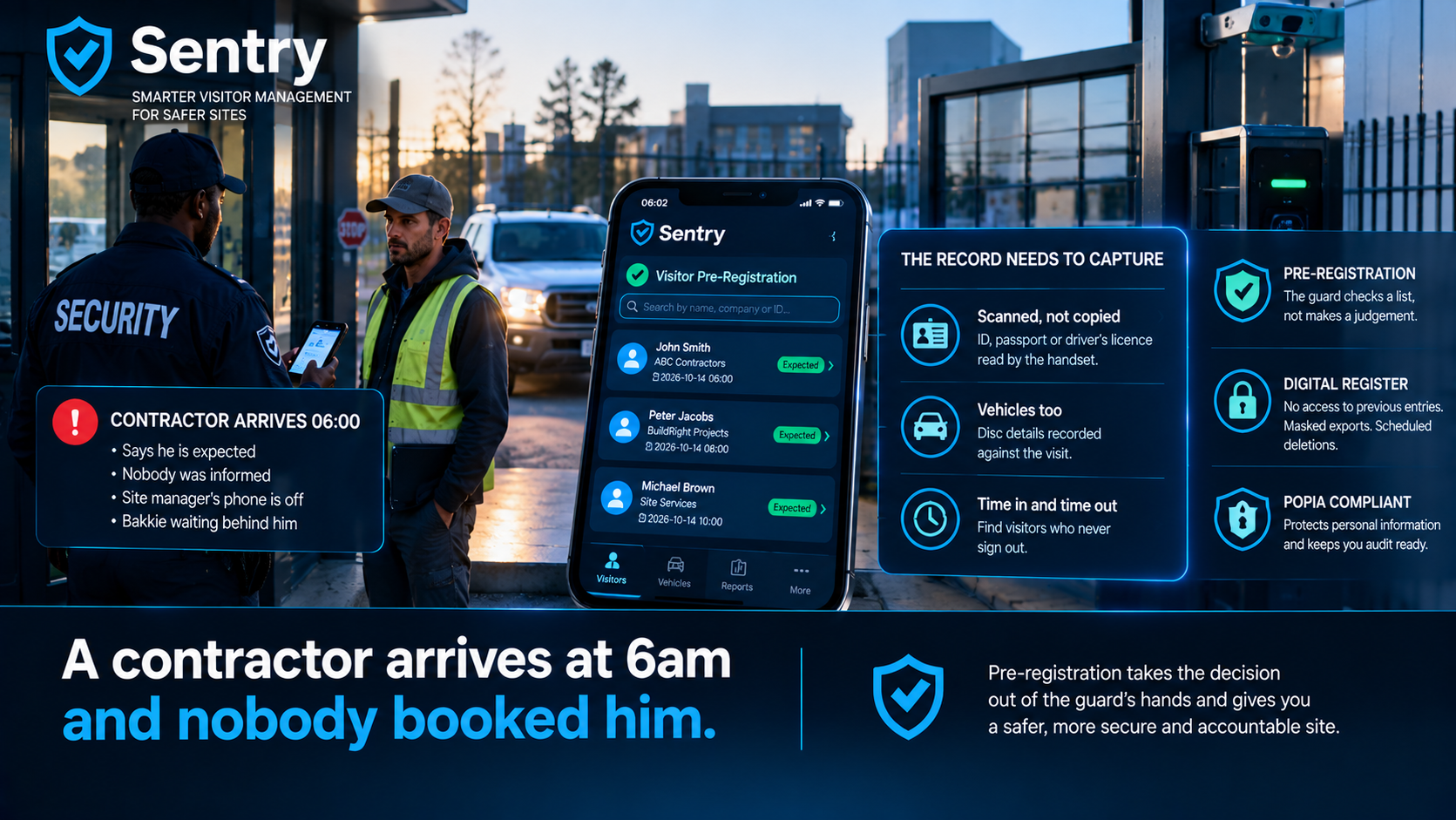
A contractor arrives at the gate at 06:00. He says he is expected. There is no visitor registration for him, nobody told the guard, the site manager's phone is off, and there is a bakkie behind him waiting.
Whatever happens next is a decision your guard makes alone, at the gate, with no information. That is the problem worth solving, and it is not really a visitor management problem. It is a decision-support problem.
The two bad outcomes
He is turned away and he was expected. Now a job does not happen, somebody senior is angry by 08:00, and the guard is blamed for following the rule. The lesson learned on the gate is that following the rule is punished, which is the expensive part.
He is let in and he was not expected. Somebody was on site who should not have been, and the record of it is a name in a book that may or may not be his.
Both come from the same cause: the decision is made by the person with the least information, at the moment with the least time.
Visitor registration in advance is not admin
Pre-registration looks like paperwork for the office and turns out to be protection for the guard.
If the contractor is on an expected list with a date and a company, the guard is not making a judgement call, they are checking a list. If he is not on it, the guard is not refusing a person, they are applying a rule that somebody else set, which is a completely different conversation at 06:00 with a bakkie waiting.
The value is not the list. It is that the guard is no longer the one deciding.
What the record needs
Once he is through the gate, what you keep matters as much as whether you let him in.
Scanned, not copied. An ID, passport or driver's licence read by the handset rather than transcribed by hand removes the illegible-handwriting problem and the transcription errors that make a register useless when you search it later.
Vehicles too. Disc details recorded against the visit. Most sites care more about the vehicle than the person, and a registration written in biro at 06:00 in bad light is frequently wrong.
Time in and time out. The second one is the one everybody forgets. Dwell time is how you find the visitor who came in this morning and never signed out, and that is a question worth being able to ask at the end of every day rather than after an incident.
The part that is quietly a legal problem
A paper visitor book on a counter holds hundreds of ID numbers, open at the current page, in a room every subsequent visitor walks through. Each person signing in can read the details of everyone before them.
Under POPIA that is difficult to defend. There is no access control, no retention period, no record of who read it, and if it disappears nobody knows. It survives because it has always been there and because nobody has framed it as a data problem.
A digital register fixes the structure rather than the discipline: a visitor cannot read the previous visitor's entry, exports can be masked so an operations report does not carry full ID numbers, and records are deleted on a schedule instead of accumulating in a storeroom.
Related: what PSIRA and POPIA actually require you to keep, and for how long.