What to write in an occurrence book so it holds up six weeks later
All in order. 02:00. Signed. The most common occurrence book entry in the industry, and it protects nobody. Four things a useful entry answers instead.
"All in order." 02:00. Signed.
That is the most common entry in a security occurrence book, and it is worth nothing. It does not tell a client anything, it does not protect the guard who wrote it, and six weeks later when something is being reconstructed it is indistinguishable from an entry somebody invented on the way home.
Knowing how to write a security occurrence book entry comes down to four things. Most entries answer none of them.
What, specifically
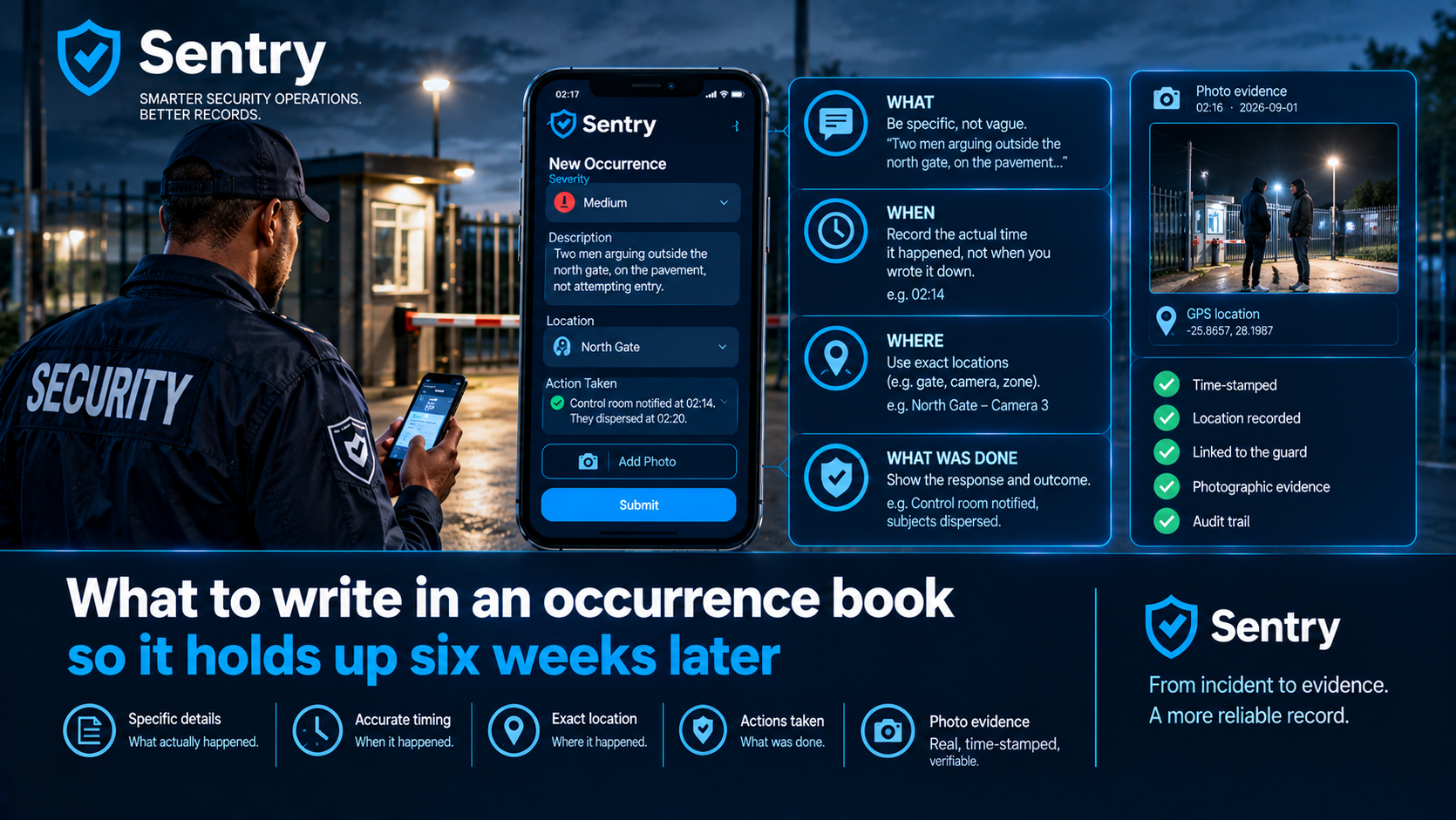
"Disturbance at the north gate" is not specific. "Two men arguing outside the north gate, on the pavement, not attempting entry" is.
The test is whether somebody who was not there can picture it. Vague entries are usually written by someone who does not want to overstate what they saw, which is a good instinct expressed badly. The answer is to record exactly what was observed, including the uncertainty: "could not see whether either was armed" is a legitimate and useful thing to write down.
When, exactly
Not the time the entry was written. The time the thing happened.
These drift apart constantly in a paper book, where entries get written at the end of a round or the end of a shift, and the times are reconstructed from memory. A digital entry timestamps itself, which removes the reconstruction, but only if guards enter things as they happen rather than batching them at 06:00.
That is a supervision question more than a software one. The software makes it possible to get right; it does not make people do it.
Where
A site is not a point. "At the perimeter" covers several hundred metres and a client asking about a specific camera blind spot is asking about a particular part of that perimeter.
An entry logged from the handset carries a position with it, which converts "at the perimeter" into something checkable, and means the entry and the patrol record support each other rather than being two accounts to reconcile.
What was done about it
The part most often missing. An observation without an action is half a record.
"Two men arguing outside the north gate" and "two men arguing outside the north gate, control room notified at 02:14, they dispersed at 02:20, no entry attempted" are different documents. The second one demonstrates that your operation responded. The first leaves a client asking what you did, with no answer available.
Photographs change the conversation
A photograph attached to an entry, timestamped and positioned, ends most disputes before they start. It is also the single easiest improvement available to most operations, because every guard already has a camera in their hand and the barrier is purely that a paper book cannot hold one.
The caution: photographs of people are personal information. A photograph of damage to a fence is not the same thing as a photograph of a visitor's face, and the second needs a reason, a retention period, and access control. Treat the occurrence book as a record that will be read by people other than you, because eventually it will be.
How to write a security occurrence book entry that holds up six weeks later
Every point above is about the same moment: somebody, possibly a client, possibly a lawyer, reading the record long after everyone involved has forgotten the night.
A paper book fails this in a specific way. It is complete, mostly legible, and entirely unverifiable. Nobody can tell which entries were written at the time and which were filled in afterwards, and once that doubt exists it applies to all of them, including the honest ones.
That is the real argument for a digital occurrence book, and it is not convenience. It is that entries made at the time, with their own timestamps and positions, are believable in a way a book cannot be, and the entries that most need to be believed are the ones written on the worst night of the year.
Related: what a defensible attendance record contains, and what to send a client who disputes a shift.